Rent is due on the 1st. The electricity bill lands on the 5th. Groceries need restocking every few days. It’s the same rhythm every month — and for most people, all of it runs through a bank account.
But a growing number of crypto holders are asking a different question: what if none of it had to? What if rent, bills, and groceries could all be paid straight out of a USDT or USDC balance — no bank account acting as the middleman?
It sounds like a crypto-native fantasy, but Cardaxo is already offering it to its consumers. In 2026, it’s closer to reality than most people think — but it comes with real trade-offs worth understanding before you try it.
Why Stablecoins (Not Bitcoin) Make This Possible
The idea of “living on crypto” has been around for years, but it never quite worked for everyday spending — because Bitcoin and Ethereum move too much. Nobody wants to pay for groceries today with an asset that might be worth 8% less by the weekend.
Stablecoins solve that problem by design. USDT and USDC are pegged 1:1 to the US dollar, which means the number in your wallet doesn’t swing with the market. That stability is exactly what a household budget needs — predictability, not upside. If you’re still holding spendable balances in BTC, it’s worth reading why USDT and USDC are better than Bitcoin for everyday purchases before you try to budget with them.
At the same time, stablecoin acceptance has quietly expanded. Card networks are settling transactions on-chain, merchant acceptance is growing, and virtual crypto cards like Cardaxo is now convert stablecoins to fiat instantly at checkout — which is the piece that actually makes “paying rent in USDC” possible in practice.
Breaking Down a Real Household Budget
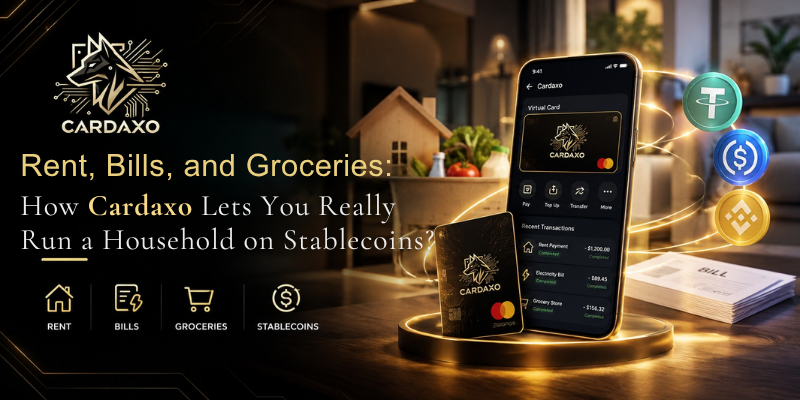
Here’s what running a household on stablecoins using Cardaxo actually looks like, expense by expense.
Rent: Most landlords aren’t set up to accept USDT directly — and that’s fine. Load your Cardaxo with stablecoins, and it will convert them to fiat at the moment of payment, so the transfer happens like any other card payment, even though the underlying funds never touched a bank account.
Utilities — electricity, water, internet: Recurring bills work the same way. Add your Cardaxo virtual card details to the utility provider’s auto-pay system, and each month’s bill gets settled from your stablecoin balance automatically.
Groceries: This is where it feels most normal. Tap-to-pay through Apple Pay or Google Pay, powered by a stablecoin-funded Cardaxo virtual card, works at checkout exactly like a regular debit card — no explaining crypto to the cashier.
Transport: Same mechanism — daily, small transactions that draw down your stablecoin balance in real time. Thanks to Cardaxo, you are not too far from using your stablecoin.
A simplified monthly view might look like this:
Expense | Approx. Monthly Cost | Paid Via |
Rent | $700 | Virtual card (auto-converted) |
Electricity + Water | $60 | Auto-pay linked to card |
Internet | $30 | Auto-pay linked to card |
| Groceries | $250 | Tap-to-pay (Apple Pay / Google Pay) |
| Transport | $80 | Tap-to-pay |
| Total | ~$1,120 | Entirely from stablecoin balance |
The Practical Challenges (Let’s Be Honest)
This isn’t friction-free, and any guide that pretends otherwise isn’t being straight with you.
Not everyone accepts crypto directly. Your landlord almost certainly wants fiat currency, not USDC. That’s precisely why the Cardaxo is the tool doing the real work here.
Fees exist, just smaller ones. Network fees for moving stablecoins, plus any card conversion spread, are usually far lower than what you’d lose to traditional bank FX markups on international spending — but they’re not zero.
Liquidity management matters. You need enough stablecoin sitting in a “spendable” balance versus locked into staking or savings. Running out mid-month because your funds are earning yield elsewhere is a real risk.
KYC and compliance still apply. A card that converts crypto to fiat is a regulated financial product, which means identity verification is part of the process — this isn’t an anonymous workaround.
How Cardaxo Virtual Card Actually Makes This Work
The mechanism is simpler than it sounds. You hold USDT or USDC in your wallet. At checkout — online or in person — the card draws from that balance and converts it to fiat instantly, settling the transaction the same way any Mastercard payment settles. There’s no manual step of “cashing out to a bank first.”
This is the exact gap explained in Cardaxo’s guide to using a crypto card for everyday expenses: the card is what turns a stablecoin balance into something a landlord, a grocery store, or a utility company can actually accept — no different from spending fiat, from their side of the transaction.
Cardaxo adds a few things worth noting for anyone running this on a real budget: no credit check to get a virtual card, multi-crypto support so you’re not locked into a single stablecoin, and Candy Rewards that pay out cashback without a lockup period — a meaningful bonus when you’re funneling your entire monthly spend through one card.
Who This Actually Works Best For
This isn’t a fit for everyone, and that’s fine. It tends to work best for:
- Freelancers and remote workers who are already paid in USDT or USDC and would otherwise convert everything to fiat manually.
- Crypto-native households already holding stablecoins as their primary savings vehicle.
- People in high-inflation economies where holding value in a dollar-pegged stablecoin is more attractive than holding local currency — a pattern already visible among expatriates using crypto cards to send money home more cheaply.
Tips If You Want to Try It
- Automate what you can. Set up recurring payments for bills the same way you would with a bank, so nothing slips through because you forgot to manually convert funds.
- Track spending like you always would. Living on stablecoins doesn’t remove the need for a budget — fund your card as per your requirements and keep a tap on it.
- Start with one category before going all-in. Move groceries or one recurring bill onto the card first, get comfortable with the flow, then expand to rent and the rest.
So, Can You Really Run a Household on Stablecoins?
Increasingly, yes — not as a theoretical crypto experiment, but as a practical way to spend money you’re already holding on-chain. The stablecoin solves the volatility problem. Cardaxo solves the acceptance problem. Together, they close the gap between “holding crypto” and “living on it.”
It won’t replace a bank account for everyone overnight, and it shouldn’t — the point isn’t ideology, it’s whether it makes your monthly budget simpler. For a growing number of freelancers, remote workers, and crypto-first households, it already does.
Ready to move your first bill onto stablecoins? Get your Cardaxo virtual card and see how much of your monthly budget you can run without touching a bank.
Read more: Lock In the Green: Using Cardaxo to Convert Trading Peaks into Real-World Purchases Before the Dip
Not financial advice. Cryptocurrency assets are volatile and unregulated in many jurisdictions — understand the risks before shifting recurring expenses onto a crypto-funded card.