Tap-and-go payments changed how the world spends money. Apple Pay and Google Pay made checkout feel almost invisible — no cards to dig out, no PIN pads, just a phone and a beep. But for crypto holders, that same convenience has been missing. Digital assets sit in a wallet, disconnected from the register, the app, the subscription bill.
Cardaxo closes that gap. It brings the tap-and-go experience people already expect from Apple Pay to Web3 assets, without asking users to give up the parts of crypto that matter — self-custody, rewards, and control.
The Apple Pay Standard — Why It Won
Contactless payments succeeded because they removed friction. No manual card entry, no swiping, no waiting — just a tap and a confirmation. That standard has quietly become the baseline expectation for any payment method in 2026, including ones built on blockchain rails.
For a crypto card to compete, it isn’t enough to just “work.” It has to feel as fast and unremarkable as tapping an iPhone at a coffee counter.
The Problem With Crypto Payments Today
Most crypto holders still can’t spend the way they hold. Converting an asset into usable currency usually means:
- Moving funds to an exchange
- Waiting on conversion or withdrawal times
- Paying gas fees and exchange spreads
- Hoping the merchant even accepts crypto in the first place
This gap between holding crypto and spending it is exactly what’s explored in Cardaxo’s comparison of virtual crypto cards vs. traditional payment methods — most people don’t abandon crypto because they don’t believe in it, they abandon spending it because it’s inconvenient.
Inside Cardaxo’s Contactless Experience
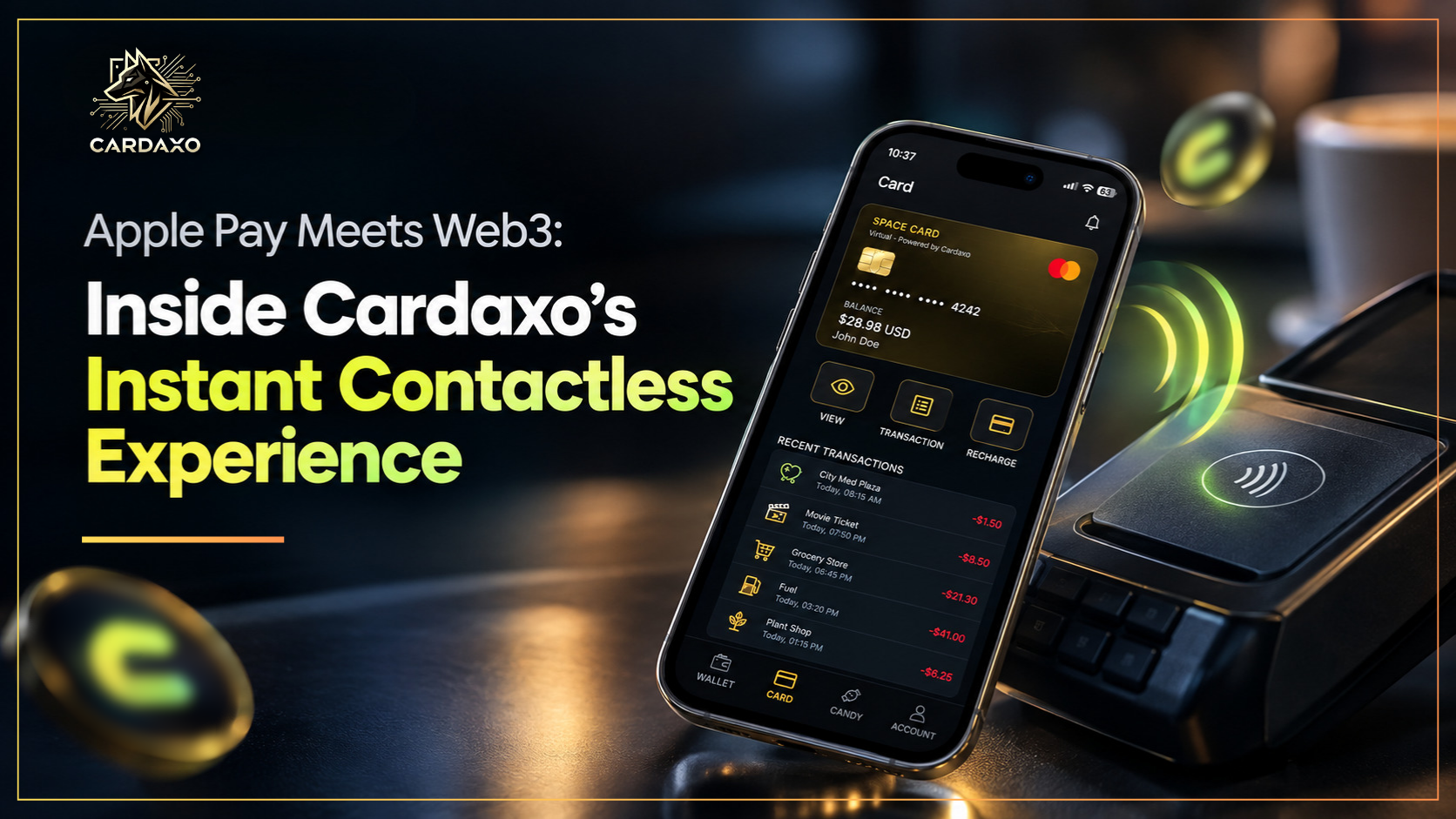
Cardaxo’s card — virtual or physical — links directly to Apple Pay and Google Pay, so the tap itself feels identical to any other contactless card. What’s different happens a layer beneath that:
- Wallet to card — crypto balance is linked to the Cardaxo card, virtual or physical
- Tap at checkout — standard NFC contactless payment, same as any Mastercard-enabled terminal
- Real-time settlement — the crypto-to-fiat conversion happens at the moment of purchase, so the merchant is paid in the currency they accept
- Reward accrual — the transaction is logged and CANDY token rewards are credited
For readers who want the deeper technical and fee breakdown of how this plays out card-to-card, the Cardaxo Crypto Card Review: Fees, Limits & Real User Experience is a good companion read.
Where Web3 Adds Value Beyond Apple Pay
Apple Pay is a conduit — it moves money that’s already in a traditional bank account. Cardaxo does something Apple Pay alone can’t:
- Self-custody — funds stay in a user-controlled wallet until the moment of spend, not sitting idle in a bank
- Rewards in CANDY — every transaction earns tokens back, a model explained in detail in Cardaxo’s Candy Rewards: Does No-Lockup Really Change the Game?
- Borderless usability — spend the same wallet balance whether you’re paying for coffee locally or a SaaS subscription abroad, a use case covered in Pay for SaaS with Crypto: Cardaxo Virtual Card for Developers
Security & Trust
Combining Apple Pay’s contactless layer with a crypto backend raises an obvious question: is it safe? Cardaxo’s approach layers encryption, KYC-based account access, and secure conversion technology — covered in full in Crypto Card Security Explained: How Cardaxo Protects Users. The short version: every transaction is encrypted end-to-end, and the virtual card format (unique card number, expiry, CVV) keeps the underlying wallet details separate from what a merchant ever sees.
Real-World Use Case Walkthrough
Picture ordering dinner through Swiggy or Zomato, or restocking on Amazon — all paid for directly from a crypto balance, tapped through Apple Pay, with no manual conversion step. That exact scenario is walked through in Can You Really Spend Crypto at Amazon, Swiggy & Zomato? Here’s How Cardaxo Makes It Possible — worth a read if you want to see the flow end-to-end.
What This Means for the Future of Payments
Contactless was step one. Bringing Web3 assets into that same tap-and-go moment is step two. As more users get comfortable spending crypto the way they spend fiat, cards like Cardaxo’s are positioned to sit at that intersection. If you’ve been following how the community discovers and grows around Cardaxo, the recent Cardaxo Referral Program: How to Earn Free Candy Tokens by Inviting Friends is a relevant next read.
Conclusion
Apple Pay set the bar for what a payment should feel like: fast, simple, invisible. Cardaxo takes that exact experience and extends it to Web3 — so a crypto wallet can finally work as easily as a bank card, without giving up ownership of the asset itself.
Explore how Cardaxo’s contactless card works → cardaxo.com