Blockchain sounds like one of those complicated concepts that only programmers can decode. However, once you come across someone who could walk you through the concept, you will realise it is relatively easier than most people think.
Over the last few years, the term has exploded across the internet, appearing almost on every platform now and then. It has emerged from tech-savvy platforms and has become a topic of our dinner table conversations.
You hear about it when discussing crypto, Bitcoin, Web3, payments, NFTs, and even gaming. Big businesses are investing in it, while the government is trying to regulate it, and we, well, most of us are trying to figure out the big deal around it.
Most of us, when we search for what is blockchain? Come across articles explaining it in technical jargon, in this article, however, we will try to learn about it more simply. We will not only learn why blockchain was created and how it works. But also, we will try to understand why many experts believe that it will shape the future of the digital economy.
This is a complete what is blockchain full guide 2026 designed for anyone who wants a clear and simple understanding of blockchain without much technicality.
What Exactly Is Blockchain?
The easiest simple explanation of blockchain is this:
Blockchain is basically a digital system used to record information securely across many computers instead of storing everything in one central place.
It is like a Google Sheet shared between the global team of thousands. They can access it at the same time, they can see the updates, but nobody can edit the old records. In simple terms, once information is added, it becomes extremely difficult to change or remove it.
This structure makes blockchain transparent, secure, decentralised, and difficult to manipulate.
Blockchain explained for beginners: Let us understand through an example. Suppose someone sends crypto to another person; this transaction by them will get recorded on a blockchain. As soon as it is verified, it becomes a permanent part of the digital log. Nobody could then secretly alter it.
This is the reason many people describe it as a trust machine. A system built on trust through technology rather than in a company or bank, etc.
Why Was Blockchain Created?
Now, let us deep dive into what blockchain was designed to solve.
For decades, the system relied on banks and other financial institutions for online transactions. Whether it is about sending money abroad, making payments, or transferring assets, the traditional financial network always acted as a middleman.
Now, this system works, but there are multiple flaws.
- International transfer can be a slow process, taking days to get payments transferred.
- Banking fees can be another issue, absorbing a big chunk of the transferred amount.
- Transfer can also face issues in complicated and conflicting economies, getting delayed or blocked.
- Centralised institutions remain the sole authority, and people have to rely on them completely.
- There are areas globally where people have limited or no access to the traditional banking system.
Blockchain was created to come out of these situations and have an alternative approach. The main motive was not to keep people dependent on one central authority, but to use a decentralised network directly. This meant faster payments with more transparency and lower fees. This provided more control over the assets and less dependency on intermediaries like banks.
This idea, when introduced in 2009 after the launch of Bitcoin, was welcomed broadly. The reason was simple. It used peer-to-peer digital payments.
How Does Blockchain Work? (Simple Step-by-Step)
Understanding how blockchain works becomes easy when broken into simple steps.
Step 1- Making a Transaction
A person makes a transaction by sending crypto to a friend or buying a digital asset. This transaction enters the blockchain network.
Step 2 – Certifying the Transaction
Nodes in the blockchain network check whether the transaction is valid. They basically check things like, does the sender actually own the funds?, is the information accurate?, or does the transaction follow network rules?
This verification process helps prevent fraud and duplicate transactions.
Step 3 – The Transaction Is Added to a “Block”
Once verified, the transaction joins other verified transactions. These transactions are grouped into a digital container called a “block.” It is something like adding a new page in your spiral binder. Exactly!
Step 4 – The Block Gets Connected to Previous Blocks
The new block gets linked to earlier blocks in chronological order. This creates the “chain” in blockchain. Each block contains references to the previous block, creating a secure, connected history.
Do you now understand the meaning of blockchain? Block + Chain = Blockchain
Step 5 – The Record Becomes Permanent
After being added to the blockchain, the record becomes extremely difficult to change or delete. Since copies exist across thousands of computers, altering one copy cannot change the entire network. This permanence is one of the biggest reasons blockchain is considered secure and trustworthy.
Why Is Blockchain Secure?
One of the key reasons for Blockchain’s rapid growth is the security it offers.
Decentralization
Traditional databases are usually stored on one central server. Blockchain works differently. Copies of the blockchain are stored across many computers worldwide. This decentralised structure removes single points of failure. If one system fails, the network still continues working.
Encryption
Blockchain uses advanced cryptography to protect data. Transactions are secured using complex mathematical algorithms that help prevent tampering and unauthorised access.
Transparency
Most public blockchains allow anyone to view transaction histories. This transparency increases trust because records can be independently verified.
Distributed Copies
Thousands of copies of the blockchain exist simultaneously. Hacking one computer cannot change the whole blockchain because the network would reject false data. This is one of the strongest security advantages of blockchain technology.
Real-Life Uses of Blockchain
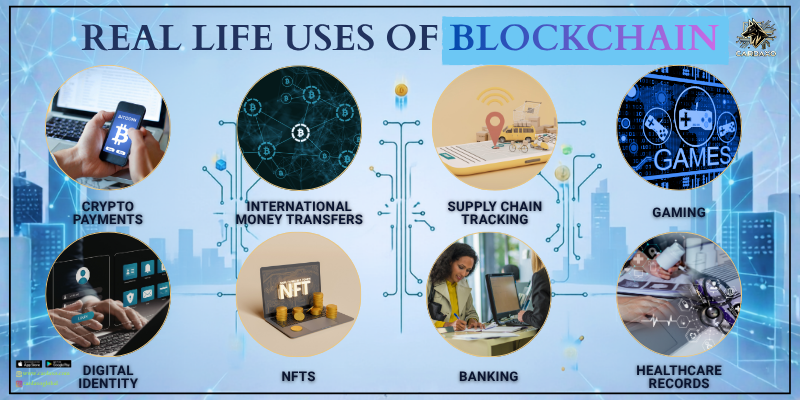
It is a common notion that the blockchain only relates to crypto. However, such is not the case. Its applications are expanding rapidly.
Here are some real-world examples of blockchain basics in action:
- Crypto payments: Sending digital currencies globally
- International money transfers: Faster cross-border transactions
- Supply chain tracking: Monitoring products from factories to stores
- Gaming: Digital ownership of in-game items
- Digital identity: Safer online verification systems
- NFTs: Ownership of digital art and collectibles
- Banking: Faster settlement systems
- Healthcare records: Secure patient data management
Businesses around the world are exploring blockchain because it can improve efficiency, transparency, and security across multiple industries.
Blockchain vs Traditional Banking
Here’s a simple comparison between blockchain systems and traditional banking:
Blockchain | Traditional Banks |
Decentralized | Centralized |
Faster global transfers | Often slower |
Lower fees | Higher fees |
24/7 transactions | Limited banking hours |
| Transparent records | Controlled databases |
This comparison makes it easy to understand why blockchain is attracting attention globally. However, this doesn’t mean that the blockchain will replace banks completely. Instead, many experts believe both systems may work together in the future.
What Is the Difference Between Blockchain and Bitcoin?
Many beginners confuse blockchain with Bitcoin, mixing them up with each other. They are connected, but they are not the same thing.
- Blockchain is the technology
- Bitcoin is one application built using blockchain
If we put it in layman’s terms, blockchain is like the internet, and Bitcoin is like one website running on the internet.d
This distinction is important when learning blockchain for beginners because blockchain technology has many uses beyond cryptocurrency.
Advantages of Blockchain
There are several reasons why blockchain is considered revolutionary.
Transparency: Transactions can be publicly verified, increasing trust.
Security: Encryption and decentralisation make blockchain difficult to hack.
Faster Payments: Cross-border payments can happen much faster compared to traditional systems.
Lower Costs: Fewer intermediaries often reduce transaction fees.
Global Accessibility: Anyone with internet access can potentially use blockchain services.
No Middlemen: Blockchain allows direct peer-to-peer interactions.
These benefits explain why blockchain adoption continues to grow worldwide.
Limitations of Blockchain
Although blockchain has many advantages, it also has challenges.
Some Networks Can Be Slow: Certain blockchain networks may experience congestion during high usage periods.
Regulations Are Still Evolving: Governments worldwide are still developing rules around blockchain and crypto assets.
Scams Exist in the Crypto Space: Not every blockchain project is legitimate. Users should always research carefully before investing.
Requires Internet and Digital Knowledge: People need internet access and basic digital understanding to use blockchain services effectively.
A balanced view is important when discussing blockchain explained topics.
Why Blockchain Matters in the Future
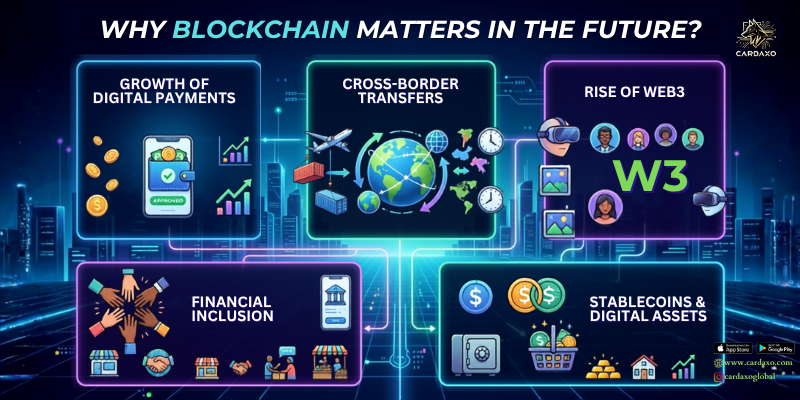
Blockchain technology is becoming increasingly important in the digital economy.
Several trends are driving adoption:
Growth of Digital Payments: More people are moving toward online and digital transactions.
Cross-Border Transfers: Blockchain can help make international payments faster and more affordable.
Rise of Web3: Web3 aims to create a more decentralized internet where users have greater control over data and digital assets.
Financial Inclusion: Blockchain may help provide financial services to millions of unbanked individuals worldwide.
Stablecoins and Digital Assets: Digital currencies linked to traditional assets are gaining popularity for payments and global commerce.
As blockchain ecosystems continue growing, many businesses are exploring crypto payment systems and decentralised financial tools to improve efficiency and accessibility.
Final Thoughts
So, what is blockchain in the simplest terms?
Blockchain is a secure digital system that helps people store and transfer information without relying entirely on a central authority.
It works like a shared digital record book that is transparent, decentralised, and difficult to alter. From crypto payments to gaming, healthcare, and banking, blockchain technology is already changing how information and value move across the internet.
Most importantly, you don’t need to be a developer or tech expert to understand blockchain.
Once you learn the basics, the concept becomes surprisingly simple.