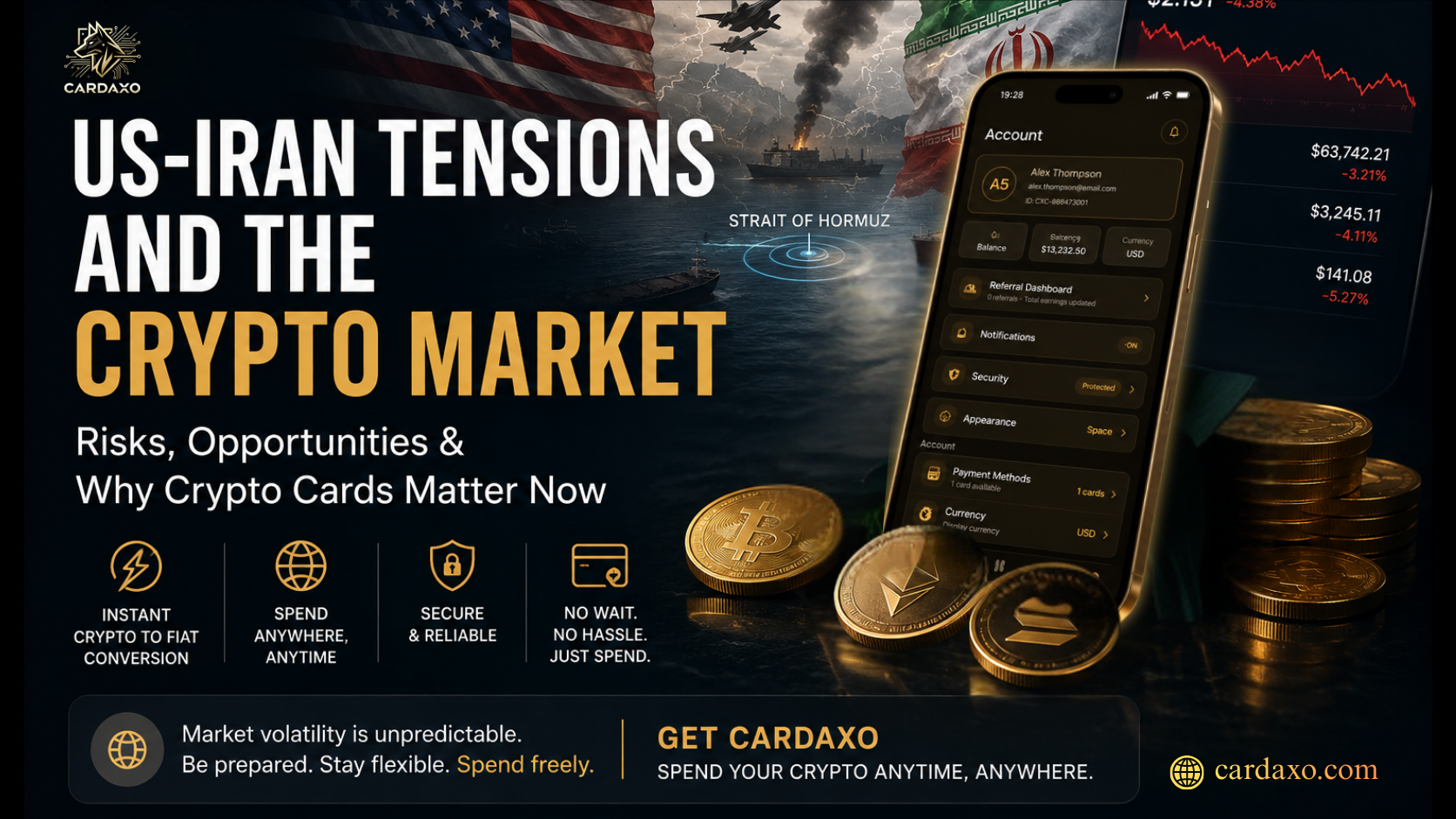
Within days of renewed hostilities between the United States and Iran, the crypto market lost tens of billions in value, Bitcoin swung sharply between $62,000 and $64,000, and traders scrambled to reassess risk across every major asset class. For a technology that was supposed to operate outside the control of governments and central banks, crypto reacted almost instantly to a regional military conflict thousands of miles away.
So why does geopolitics move a “decentralized” market this much — and what should everyday crypto holders actually do about it? In this guide, we break down what’s happening, why it matters for your portfolio, and why having a fast way to convert crypto to spendable cash has never been more relevant.
What’s Actually Happening in US Iran Crypto Market
Tensions between the US and Iran escalated sharply in July 2026 after a fragile ceasefire collapsed. Iranian attacks on commercial tankers near the Strait of Hormuz were followed by US airstrikes on Iranian military targets, and the conflict has since centered on control of the Strait — one of the world’s most critical routes for global oil shipments. With the waterway partially disrupted, oil prices climbed, and investors across equities, commodities, and crypto shifted into risk-off mode almost immediately (CoinDesk).
This is a fast-moving, developing situation — the details here reflect the state of the conflict as of publication and may change.
Why Geopolitical Conflict Moves the Crypto Market
It might seem strange that a war half a world away can shave billions off Bitcoin’s market cap in hours, but the mechanism is fairly simple:
- Oil and inflation. A disrupted Strait of Hormuz threatens global oil supply. Higher oil prices raise inflation expectations, which pushes investors toward safer assets and away from anything considered “risk-on” — including crypto.
- Crypto never sleeps. Unlike stock markets, which absorb news gradually between trading sessions, crypto trades 24/7. Geopolitical headlines translate into price moves in real time, with no buffer.
- Leverage amplifies the move. A large share of crypto trading happens with borrowed money. When prices drop suddenly, leveraged positions get liquidated automatically, which accelerates the fall — over $150 million in positions were liquidated within a single 24-hour window during one recent spike in tensions.
Is Bitcoin Really a “Safe Haven”?
Bitcoin is often marketed as “digital gold” — an asset meant to hold value when traditional markets get shaky. This event is putting that narrative to the test. In practice, Bitcoin has traded more like a risk asset than a safe haven during this conflict, falling alongside equities rather than acting as a hedge (Cryptonomist).
That doesn’t mean the safe-haven case is dead — it means it’s more nuanced than the marketing suggests. For a deeper look at how Bitcoin’s price behaves under pressure, see our Bitcoin Price Prediction guide.
The Risks for Everyday Crypto Holders
If you’re holding or actively trading crypto right now, a few risks are worth understanding clearly:
- Volatility risk — sharp, fast price swings in both directions.
- Liquidation risk — anyone trading with leverage is significantly more exposed during geopolitical shocks.
- Regulatory and compliance risk — conflicts involving sanctioned states historically bring tighter scrutiny of crypto transactions. The US government has previously seized hundreds of millions of dollars in Iran-linked digital assets, treating crypto as a potential sanctions-evasion channel (CryptoBriefing) — a good reminder to keep your own transactions clean and compliant, regardless of which platform you use.
The Opportunity Side
Volatility cuts both ways. Some traders view sharp pullbacks like this as entry opportunities, pointing to how crypto markets have historically recovered once past geopolitical shocks stabilized. This isn’t a guarantee — past recoveries don’t predict future ones, but it’s part of why experienced investors tend to focus on position sizing and long-term strategy rather than reacting to every headline.
If you’re new to how stable, dollar-pegged crypto assets fit into a volatile market, our Stablecoins Explained guide is a useful next read — many investors shift into stablecoins during exactly this kind of turbulence.
Why Crypto Cards Matter More Than Ever Right Now
This is where a crypto card stops being a convenience and becomes a genuine advantage.
During periods of high volatility, speed matters. If your crypto is sitting in a wallet and the market turns, moving it through a traditional exchange — waiting on withdrawal times, bank transfers, and conversion delays — can cost you real value. A crypto card like Cardaxo removes that friction: your crypto converts to fiat instantly at the point of sale, so you’re never stuck waiting on a shaky exchange to access your own money.
This matters even more if you’re someone who relies on crypto for everyday spending, cross-border payments, or access to funds in a region where traditional banking is unreliable — a scenario we cover in detail in How to Use Crypto During Global Crises for Safe & Instant Payments. Whether it’s a banking disruption, a currency crisis, or simply wanting fast access to your funds during a volatile week, having a card that bridges crypto and real-world spending gives you flexibility that holding alone doesn’t.
Practical Takeaways
- Don’t panic-trade on headlines. Sharp moves driven by news tend to overshoot in both directions.
- Avoid over-leveraging during periods of elevated geopolitical risk — this is exactly when liquidation cascades happen.
- Keep a portion of your holdings spendable, not just locked into volatile positions. Knowing how to withdraw cash using a crypto card when you need it is a form of risk management in itself.
- Stay informed, not reactive. Understand the difference between short-term noise and genuine structural risk.
This article is for educational purposes only and does not constitute financial advice. Cryptocurrency assets are highly volatile and unregulated — please ensure you understand the risks before making any investment decisions.
FAQs
Why is the crypto market down because of Iran?
Escalating US-Iran military tensions have disrupted the Strait of Hormuz, a key global oil route. Rising oil prices and broader risk-off sentiment have pushed investors out of volatile assets, including crypto.
Is Bitcoin a safe haven during war?
Not consistently. During this conflict, Bitcoin has largely traded in line with other risk assets rather than acting as a hedge, challenging the “digital gold” narrative.
How does the Strait of Hormuz affect crypto prices?
The Strait carries a significant share of global oil exports. Disruptions there raise oil prices and inflation expectations, which typically trigger a broader shift away from risk assets like crypto.
Should I sell my crypto during geopolitical uncertainty?
There’s no one-size-fits-all answer. Reacting impulsively to headlines is generally riskier than sticking to a considered strategy — this is not financial advice, and you should assess your own risk tolerance or consult a professional.
Final Thoughts
Crypto may run on decentralized infrastructure, but the people trading it are very much part of the same interconnected, headline-driven global economy as everyone else. The US-Iran conflict is a reminder that geopolitical risk doesn’t stop at your portfolio’s edge — and that having fast, flexible access to your funds matters most exactly when markets get unpredictable.
Ready to spend your crypto without waiting on shaky exchanges? Download Cardaxo and get instant crypto-to-fiat conversion, wherever life — or the market — takes you next.