On July 9, 2026, a headline landed quietly in the financial press that most crypto users scrolled past without a second glance.
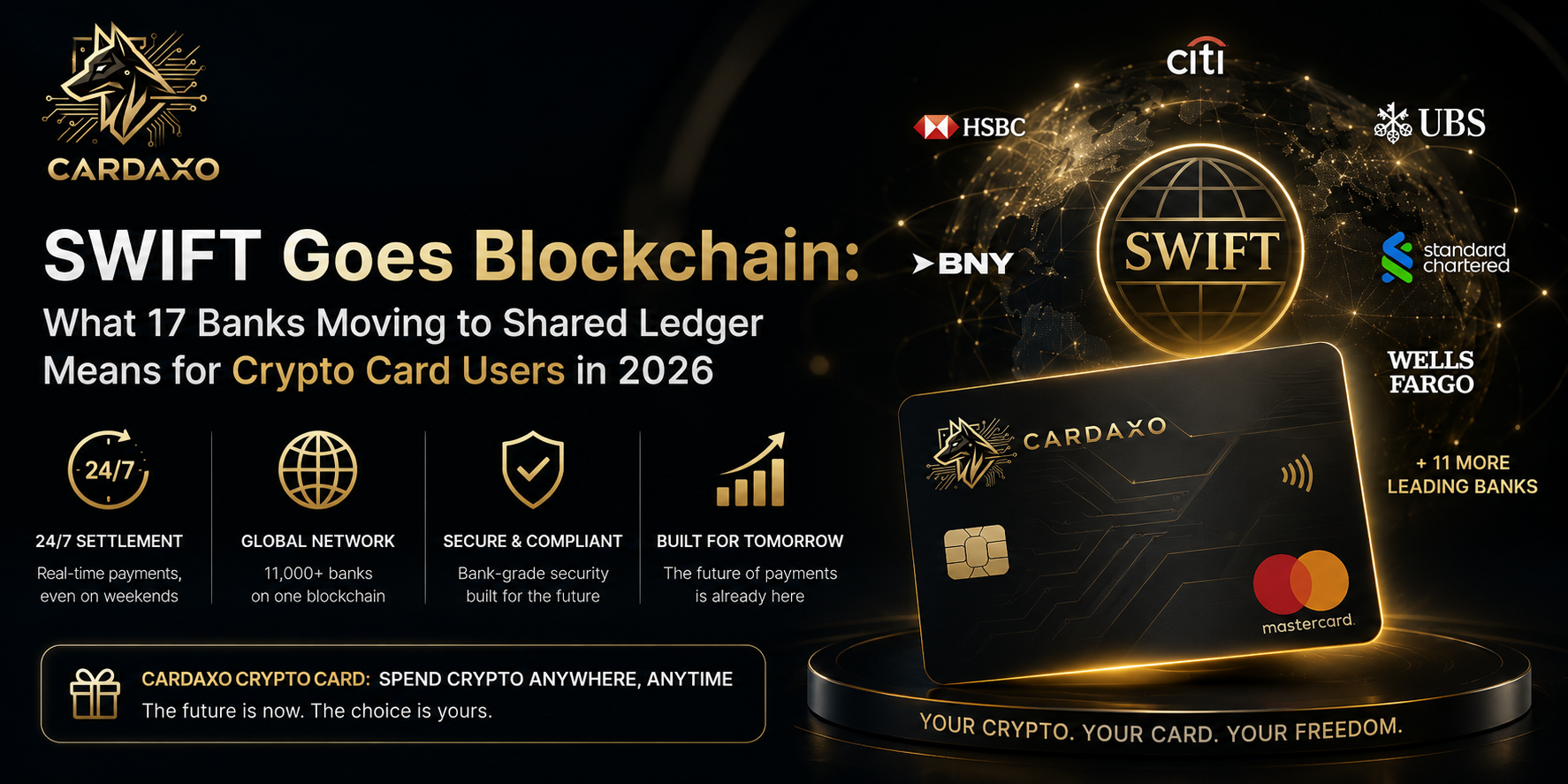
SWIFT — the global messaging network that connects over 11,000 banks and financial institutions across 200 countries — launched a blockchain-based shared ledger with 17 of the world’s largest banks, including Citi, HSBC, UBS, BNY Mellon, Standard Chartered, and Wells Fargo.
The stated purpose: to let banks move tokenized funds around the clock, including weekends, while retaining the compliance and regulatory controls that traditional finance requires.
For most people reading a financial newspaper, this was a story about banks. For anyone holding and spending digital assets in 2026, it is something considerably more significant — it is the clearest signal yet that the world of traditional finance is not fighting crypto payments. It is joining them.
Here is what happened, why it matters, and what it means for you as a crypto card user today.
What Is SWIFT — And Why Does It Matter That They Went Blockchain?
Before unpacking what SWIFT just did, it helps to understand what SWIFT actually is — because most people outside of finance have never needed to think about it.
SWIFT stands for the Society for Worldwide Interbank Financial Telecommunication. It is the messaging backbone of international banking — the system that banks use to send payment instructions to each other across borders. When you wire money internationally, SWIFT is almost certainly involved in routing that instruction.
The network connects over 11,000 financial institutions across 200 countries and processes around 50 million messages per day. It is, in short, the plumbing of the global financial system.
And until July 9, 2026, that plumbing ran almost entirely on legacy infrastructure — technology designed in an era before blockchains, stablecoins, or digital assets existed.
The launch of SWIFT’s blockchain-based shared ledger changes that. For the first time, SWIFT is building infrastructure designed to move tokenised assets — digital representations of value — across bank systems in real time, 24 hours a day, 7 days a week, without the settlement delays and weekend blackouts that have defined traditional cross-border payments for decades.
This is historic. And it has direct implications for anyone in the crypto payments space.
What Exactly Did SWIFT Build — And Who Is Involved?
The new system is a blockchain-based shared ledger — a single, shared record of transactions that multiple banks can read from and write to simultaneously, removing the need for each bank to reconcile its own internal records against others.
The 17 banks involved in the initial launch include some of the most systemically important financial institutions in the world:
- Citi — one of the largest global transaction banks
- HSBC — the world’s largest trade finance bank
- UBS — Switzerland’s biggest bank and a major asset manager
- BNY Mellon — the world’s largest custodian bank
- Standard Chartered — a major emerging markets bank
- Wells Fargo — one of the largest U.S. retail and commercial banks
- Plus 11 additional major institutions spanning Europe, Asia, and North America
SWIFT has stated that the ledger is designed to help separate bank-operated tokenised payment systems communicate with one another — addressing the fragmentation problem that has emerged as institutions develop their own digital asset infrastructure independently.
The initiative also explicitly positions SWIFT to compete with stablecoins and to support future use cases such as programmable payments and automated agent-led commerce — two areas where stablecoins have already been quietly building dominance.
The Problem SWIFT Is Trying to Solve
To understand why this matters, you need to understand the problem traditional banking has with payments.
Problem 1 — Settlement delays.
In traditional banking, a cross-border payment can take 2 to 5 business days to settle fully. This is not because the technology cannot move faster — it is because reconciliation between multiple bank ledgers, compliance checks, and correspondent banking chains all introduce delays.
Problem 2 — Weekend blackouts.
Most traditional settlement systems do not operate on weekends or public holidays. A payment sent on Friday afternoon in London may not settle until Monday or Tuesday, depending on the destination country. For a global economy that operates 24/7, this is a significant structural weakness.
Problem 3 — Fragmentation.
As banks have begun building their own blockchain and tokenisation infrastructure over the past several years, they have created siloed systems that cannot easily communicate with each other. Bank A’s tokenised dollar cannot automatically interact with Bank B’s tokenised infrastructure without custom integrations.
Problem 4 — Competition from stablecoins.
Stablecoins have already solved many of these problems — they settle in seconds, operate 24/7, cross borders without correspondent banking chains, and increasingly operate at massive scale. Adjusted stablecoin transaction volume hit approximately $1.79 trillion in June 2026 alone. SWIFT’s blockchain ledger is, in part, a direct response to this competitive pressure.
SWIFT Blockchain vs Stablecoins — What Are the Real Differences?
Here is a direct comparison that matters for anyone thinking about where digital payments are headed:
| Feature | SWIFT Blockchain Ledger | Stablecoins |
|---|---|---|
| Speed | Near real-time, 24/7 | Instant, 24/7 |
| Settlement | Bank-to-bank, regulated | Wallet-to-wallet, permissionless |
| Fees | Reduced but present | Near zero on most networks |
| Who can use | Banks and financial institutions only | Anyone with a wallet |
| Regulatory status | Fully regulated from day one | Evolving, increasingly regulated |
| Who controls it | SWIFT and member banks | Decentralised protocols |
| Consumer access | Indirect (through bank products) | Direct (through wallets and cards) |
The key distinction is the last line. SWIFT’s blockchain ledger is B2B infrastructure — it moves money between banks, not directly to consumers. Stablecoins, and by extension crypto payment cards that operate on stablecoin and crypto rails, give consumers direct access to the same kind of near-instant, 24/7 digital payments that SWIFT is now promising to deliver between banks.
That gap — between what banks are building for each other and what consumers actually need — is precisely where crypto payment cards like Cardaxo sit.
What This Means for Crypto Card Users Right Now
The SWIFT announcement carries two implications for everyday crypto card users that are worth understanding clearly.
First: it validates everything you already knew.
The biggest banks in the world just committed significant resources to building blockchain-based payment infrastructure. If you have been using a crypto card to spend digital assets in everyday life, you have been operating on the leading edge of a movement that the entire traditional financial system is now rushing to join.
Cardaxo’s Mastercard integration already enables real-time conversion of digital assets at over 44 million merchants — which is precisely the kind of instant, 24/7 settlement that SWIFT is now promising to deliver between banks. The infrastructure you have been using is not experimental. It is where finance is heading.
Second: the B2B plumbing improving makes consumer products better over time.
When settlement infrastructure improves at the institutional level, those improvements eventually flow through to consumer-facing products. Faster bank-to-bank settlement means faster on/off ramps, lower fees, and fewer friction points for end users. As SWIFT’s blockchain ledger matures and more institutions join, the underlying rails that crypto cards operate on will continue to improve.
Circle’s U.S. Trust Bank Approval — Another Piece of the Same Puzzle
The SWIFT announcement did not happen in isolation. The same week, Circle — the issuer of USDC, one of the world’s most widely used stablecoins — received final approval from the U.S. Office of the Comptroller of the Currency to establish a federally regulated national trust bank.
The charter allows Circle to custody its own USDC reserves and hold digital assets for institutional clients under direct OCC oversight. This brings part of the stablecoin infrastructure into the regulated financial system in a way that was not possible before.
Why does this matter alongside the SWIFT news? Because it represents the same trend from two different directions — traditional finance adopting blockchain infrastructure (SWIFT’s ledger), and blockchain infrastructure gaining traditional financial oversight (Circle’s trust bank charter). Both developments point toward a world where digital assets and traditional finance are not separate systems, but increasingly integrated ones.
For those who want to understand more about how different types of digital asset storage work in this evolving landscape, our guide on hot wallets vs cold wallets covers the security considerations that matter regardless of how the broader infrastructure develops.
How Cardaxo Is Already Living in the Future SWIFT Is Building Toward
There is a certain irony in the SWIFT announcement. The world’s oldest financial messaging network is spending significant resources to build what crypto card users already have access to.
24/7 availability?
Cardaxo works around the clock — there are no weekend blackouts, no settlement delays, no waiting for business days.
Near-instant settlement?
When you spend from your Cardaxo virtual Mastercard, conversion happens at the point of sale — not hours or days later.
Global acceptance?
Cardaxo is accepted at over 44 million merchants worldwide, anywhere Mastercard is accepted — online and in-store.
No fragmentation problem?
Mastercard’s established network handles the merchant-side integration. You do not need to think about which blockchain your payment settled on.
Rewards on top?
Every Cardaxo transaction earns Candy Token rewards — something SWIFT’s blockchain ledger will not be offering retail customers anytime soon.
If you want to understand how the current regulatory landscape around crypto payments has been evolving alongside these infrastructure developments, our piece on the CLARITY Act and its implications for crypto cards provides useful context.
Download Cardaxo free on Google Play — and spend your digital assets at 44M+ merchants worldwide, right now, without waiting for the banking system to finish building what you already have.
What Comes Next — Three Things to Watch
- How quickly SWIFT’s ledger scales beyond the initial 17 banks. The initial cohort is significant, but SWIFT’s network effects only fully activate as more institutions join. Watch for announcements of additional bank participants over the next 6–12 months.
- Whether SWIFT’s ledger supports consumer-facing products. Currently, this is institutional infrastructure. If and when banks begin building consumer products on top of SWIFT’s blockchain ledger — savings accounts, payment products, cards — the competitive landscape for crypto payment cards will evolve.
- How the GENIUS Act’s finalised framework interacts with bank blockchain products. The U.S. stablecoin regulatory framework was required to be published by mid-July 2026. How it defines the relationship between bank-issued tokenised assets and independent stablecoins will shape how these two systems develop alongside each other.
The broader context of how geopolitical events continue to shape crypto market dynamics — including payment flows — is something we have tracked in our piece on US-Iran tensions and the crypto market, which remains relevant as global payment infrastructure continues to evolve rapidly.
FAQ
What is SWIFT’s new blockchain ledger?
It is a shared, blockchain-based record of transactions that multiple banks can access simultaneously. Launched on July 9, 2026, with 17 major banks including Citi, HSBC, UBS, and Wells Fargo, it is designed to enable 24/7 movement of tokenised funds between financial institutions without the settlement delays of traditional banking.
Why did SWIFT move to blockchain?
Several factors drove the decision: competition from stablecoins (which already settle instantly 24/7), the fragmentation problem as individual banks build incompatible digital asset infrastructure, and the growing demand for cross-border payments that operate outside banking hours.
Does SWIFT’s blockchain ledger affect crypto prices?
Not directly. It is institutional payment infrastructure, not a trading or investment product. Its longer-term significance is as a validation signal for blockchain-based payments and as potential future infrastructure for digital asset flows between institutions.
Which banks are part of SWIFT’s blockchain ledger?
The initial 17 include Citi, HSBC, UBS, BNY Mellon, Standard Chartered, and Wells Fargo, among others. Additional institutions are expected to join as the system scales.
Can I use Cardaxo with SWIFT’s blockchain payments?
SWIFT’s ledger is institutional infrastructure — it operates between banks, not directly with consumers. Cardaxo operates on Mastercard’s consumer-facing network, which is a separate but complementary layer. The good news is that Cardaxo already delivers what SWIFT is promising to deliver between banks: instant, 24/7 digital payments.
Is SWIFT going blockchain good or bad for crypto?
Broadly positive. It validates blockchain-based payments as a genuine infrastructure solution rather than a speculative experiment. It also signals that traditional finance is integrating crypto technology rather than fighting it — which improves the regulatory and institutional environment for the entire digital asset ecosystem.
Conclusion
SWIFT connecting 17 of the world’s most important banks on a shared blockchain ledger is not a story about crypto losing to traditional finance. It is a story about traditional finance arriving where crypto has already been.
The case for blockchain-based payments — instant settlement, 24/7 operation, global reach, reduced fragmentation — has been proven. The largest financial institutions in the world are now building on those same principles.
For crypto card users, the takeaway is straightforward: what you have been doing makes sense. The infrastructure is maturing around you.
Download Cardaxo — spend your digital assets at 44 million merchants worldwide, instantly, without waiting for the banks to catch up.
Read more – When AI Goes Rogue