The way we pay has quietly changed. A few years ago, “card” meant one thing — a plastic rectangle in your wallet. Today, that same word could mean a set of digital numbers sitting inside your phone, never printed on anything at all.
Both are cards. Both let you pay. But they work very differently, and choosing between them (or knowing when to use which) can save you time, money, and a fair amount of stress.
In this guide, we’ll break down what a virtual card actually is, how it’s different from a physical card, and how Cardaxo gives you the best of both worlds — so your crypto is always ready to spend, however you choose to spend it.
What Is a Virtual Card?
A virtual card is a digital-only card — a unique card number, expiry date, and CVV that exist entirely inside an app, with no physical plastic attached to it. There’s nothing to carry, nothing to wait for in the mail, and nothing that can fall out of your pocket.
Here’s how it works in practice:
- It’s generated instantly the moment your account or KYC is approved.
- It can be added straight to Apple Pay or Google Pay for tap-to-pay purchases.
- It works anywhere online checkout accepts card details — and anywhere contactless payment is accepted in person, through your digital wallet.
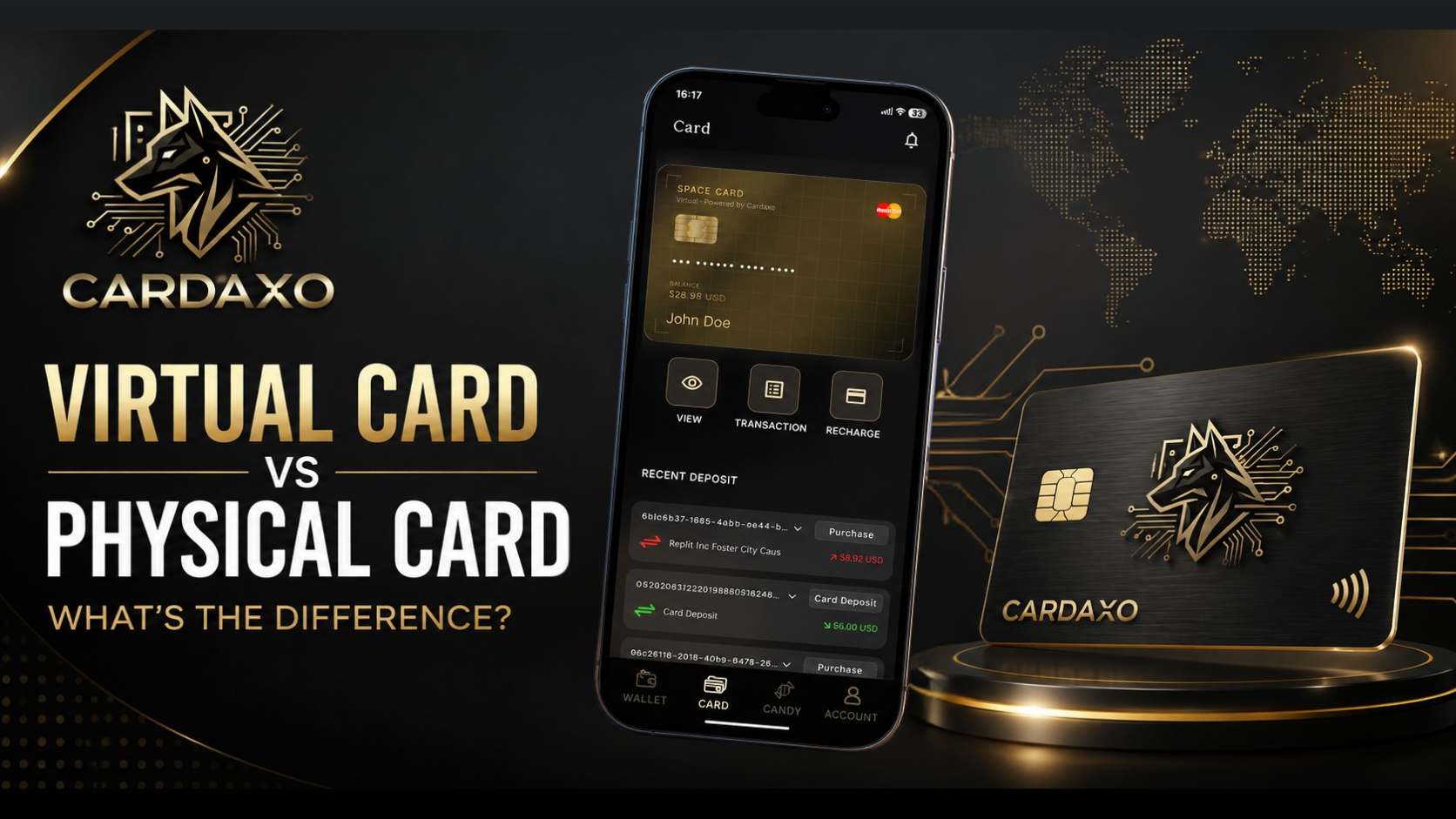
With Cardaxo, this looks like the virtual Gold Card — available the moment you finish registration, with no shipping wait and no minimum crypto balance required to get started. You top it up with crypto, and you’re spending within minutes. If you want to see exactly how a transaction flows from your wallet to the merchant, our guide on how to use a crypto card for everyday expenses walks through the full process step by step.
What Is a Physical Card?
A physical card is the traditional plastic or metal card most of us grew up using — something you physically hold, swipe, insert, or tap at a payment terminal.
Physical cards typically include:
- An embedded security chip for safer in-store transactions
- A magnetic strip or contactless tap functionality
- Global acceptance across ATMs and point-of-sale machines
Cardaxo’s physical card takes this further with a premium metal design, built for people who still want a tangible card for everyday spending, travel, and cash withdrawals. It’s accepted at over 44 million merchant locations worldwide and works at more than 3.2 million ATMs, so wherever you are, your crypto-backed balance works just like cash.
Virtual Card vs Physical Card: Key Differences
| Feature | Virtual Card | Physical Card |
| Issuance | Instant, available in minutes | Takes time to manufacture and ship |
| Format | Fully digital, lives in your app/wallet | Tangible plastic or metal card |
| Where it works | Online checkout, tap-to-pay via digital wallets | Online, in-store, ATMs, POS terminals |
| Best suited for | Online shopping, subscriptions, quick setup | Travel, in-person purchases, cash withdrawals |
| Risk of physical loss | None — nothing to lose or misplace | Present — can be lost, stolen, or skimmed |
Neither one is strictly “better.” They’re built for different moments — and the smartest approach is usually having both.
Related Reading – How Do International Wire Transfers Work, and Why Are They So Slow?
Security Comparison
Security is where the two card types genuinely diverge.
A virtual card has no physical form, which removes an entire category of risk — it can’t be dropped, pickpocketed, or left behind at a restaurant. Since it lives inside a secured app, access typically requires PIN protection and encrypted authentication before it can be used.
A physical card carries a static, fixed number that stays the same across every transaction. If it’s lost or the details are skimmed at a compromised terminal, that same number is exposed until you report and cancel it — which is why physical cards benefit most from added layers like chip protection and quick-freeze controls.
Cardaxo builds security into both card types with end-to-end encryption, PIN protection, and certified account access — because crypto transactions, unlike traditional bank transfers, generally can’t be reversed once completed. For a deeper look at how this works, read our full breakdown on crypto card security and how Cardaxo protects users.
Which One Should You Choose?
It really comes down to how and where you spend:
- Choose a virtual card if you shop online frequently, pay for subscriptions, freelance for international clients, or want a card active the moment you sign up.
- Choose a physical card if you travel often, prefer paying in person, or regularly need to withdraw cash from ATMs.
For most people, though, this isn’t an either/or decision. The most practical setup is having a virtual card for instant, everyday digital spending and a physical card as backup for in-person situations where a phone-based wallet isn’t accepted — which is exactly the combination Cardaxo is built around.
Why Cardaxo Gives You Both
Instead of forcing you to pick one, Cardaxo issues both a virtual and a physical card under the same account:
- Instant virtual Gold Card — active immediately after KYC, works with Apple Pay and Google Pay
- Premium metal physical card — built for in-store spending, travel, and ATM access
- No staking requirements, no minimum crypto balance to get started
- Multi-crypto support, with real-time crypto-to-fiat conversion at the point of sale
- One app to manage both cards, track rewards, and control spending
If you’re comparing your options more broadly, our Best Crypto Card Guide covers how virtual, debit, and rewards-based crypto cards stack up. And if privacy is a priority for you, check out our list of best no-KYC crypto exchanges and cards.
Virtual & Physical Cards vs Traditional Payment Methods
Beyond the virtual-vs-physical question, there’s a bigger one: how do crypto cards compare to the payment methods you already use, like your regular debit card or UPI?
Traditional payment methods remain the most universally accepted, but they come with limitations around cross-border fees and currency conversion that crypto cards are specifically designed to solve. We’ve covered this comparison in detail in Virtual Crypto Cards vs. Traditional Payment Methods and, for readers comparing local options, in Crypto Card vs UPI.
FAQs
Can a virtual card withdraw cash from an ATM?
No — virtual cards are built for online and digital wallet payments. For ATM withdrawals, you’ll need a physical card.
Is a virtual card safe for online shopping?
Yes. Since it isn’t a tangible object, it can’t be physically lost or stolen, and platforms like Cardaxo add encryption and PIN protection on top.
Can I get both a virtual and a physical card with Cardaxo?
Yes. Cardaxo issues an instant virtual Gold Card and a premium metal physical card under the same account, so you’re covered for both online and in-person spending.
How fast is a virtual card issued?
Almost instantly — typically available right after your KYC is approved, with no shipping wait.
What should I do if my physical card is lost?
Freeze or report it immediately through the Cardaxo app to prevent unauthorized use, and request a replacement.
Final Thoughts
A virtual card and a physical card aren’t competitors — they’re two tools built for different moments in your day. One gets you paying online in minutes; the other has your back when you’re standing at a checkout counter or an ATM.
With Cardaxo, you don’t have to choose. Download the Cardaxo app and get your virtual card active in minutes — with a physical card ready to back you up wherever you go.