For years, sending money home has been part of the expat lifestyle. Every payday is followed by another normal part of their lives, sending money back home.
No matter where people move, Dubai, London, Singapore, Canada, or Australia, their routine stays the same: work hard and save carefully. Remittances are an unavoidable part of their working routine.
But the most frustrating part is the additional price they pay to send money home. Even in 2026, as we talk, international money transfers are still surprisingly expensive. Traditional banks take their cuts and still take days to make the transfer. Traditional remittance services mysteriously add hidden costs in their exchange rates. ATM withdrawals automatically incur foreign transaction fees. In short, somehow, a simple process of ‘sending money’ becomes a difficult-to-understand chain reaction of multiple fees. So by the time money reaches the family, a huge chunk has already disappeared.
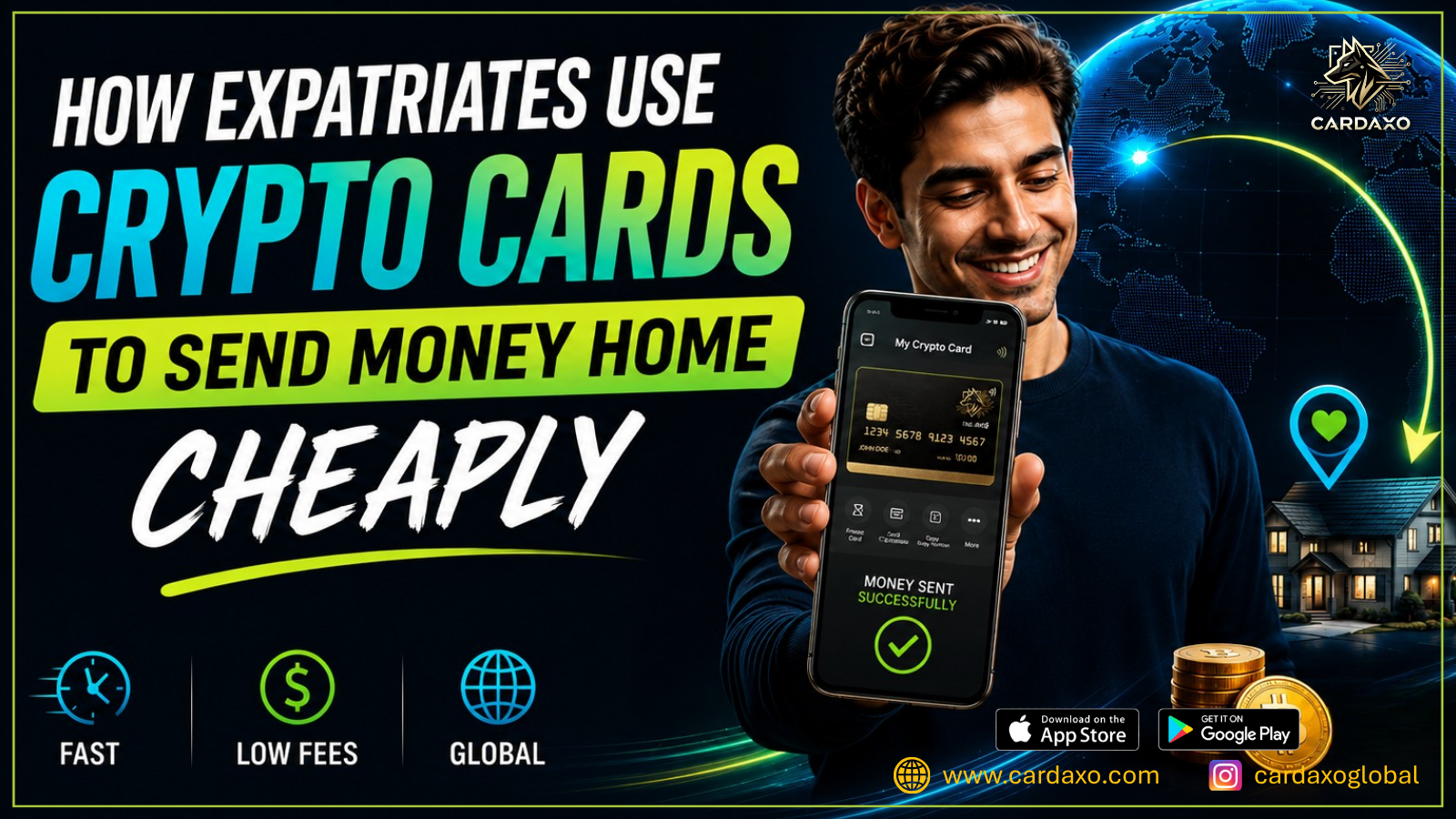
That is exactly why more and more people are opting for crypto cards for expats sending money home. It has emerged as the best way to use their hard-earned money, not because it sounds futuristic, but because people are tired of losing it every month. This way, instead of relying only on the banks, expatriates are combining stablecoins, digital wallets, and crypto virtual cards to enable faster and cheaper global payments.
Why Traditional Remittances Still Cost So Much
Before understanding crypto card remittance systems, let us understand where traditional services become expensive.
Imagine this. Maria, a caregiver in Italy, sends €400 home to the Philippines every month. On paper, the transfer fee is as little as €5 or €6. But that’s not the real cost. The exchange rate is usually worse than the market rate, and she is always charged differently. Sometimes there’s a receiving fee, sometimes the money arrives late, or sometimes, if the family withdraws cash via ATM, they lose more money in ATM charges. In the end, her family ends up receiving €20–€30 less than expected.
Now multiply that by 12 months. This is what she loses because of the borders.
Send Money Home Without Hidden Fees
Discover how crypto cards help expats transfer money internationally faster and at lower costs.
Explore Crypto CardsA normal international bank transfer usually includes:
- Transfer fees
- Currency conversion charges
- Hidden exchange-rate spreads
- Receiving bank fees
- ATM withdrawal charges
- Delays from intermediary banks
This is the main reason search engines are increasingly being flooded with questions like-
- What is the cheapest way to send money internationally
- Expat money transfer low fees
- How to send money abroad cheaply
And as the answer for most of them, payments through crypto and spending through crypto cards are the end of the conversation.
What Is a Crypto Card?
A crypto card is similar to a traditional bank card. The only difference is that the currency behind it is crypto and not regular money. This way, they are not connected with any traditional bank account or financial services.
Most cards allow users to:
- Hold stablecoins like USDT or USDC
- Spend crypto directly
- Convert crypto into local currency instantly
- Withdraw cash internationally
- Make online purchases globally
These cards are usually integrated with a global payment system like Visa or Mastercard, so they work almost anywhere regular cards are accepted. For expats, this emerges as a powerful shortcut around the traditional banking system.
Instead of opting for traditional transfers, waiting for several days, and paying multiple fees, they buy stablecoins, send them to their crypto wallet instantly, and let family members spend via a crypto-linked card. The most lucrative appeal of this modern crypto remittance system is fewer middlemen, fewer fees, and less wait time.
How crypto is the cheapest way to send money internationally
Raul works as a mechanical technician in Dubai. And used traditional remittance apps to send money back home. However, he always noticed that his money was never received by his parents at the rate he sent online. Hidden charges, transfer fees, etc., always cost him extra.
It was in his extreme frustration that he discussed his problem with his colleague, who introduced him to crypto cards. This changed the sending game entirely. Now, he buys USDT using AED and sends it to his family’s crypto wallet. His brother then loads the funds onto a crypto card and uses it to make a purchase. The entire process, from the transfer to the loading of the crypto in the card, took only a few minutes. This cut off the waiting time of 2-3 days while dropping the fees dramatically.
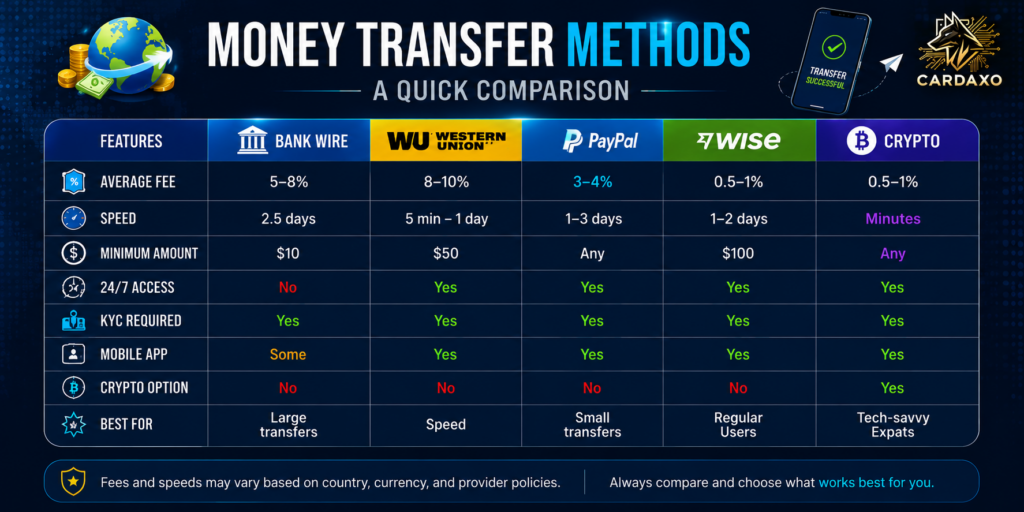
Remittance fees comparison 2026- The comparison of remittance fees charged by different organisations made it clear why crypto is the best way to send money home without bank fees.
| Features | Bank wire | Western Union | PayPal | Wise | Crypto |
|---|---|---|---|---|---|
| Average Fee | 5-8% | 8-10% | 3-4% | 0.5-1% | 0.5-1% |
| Speed | 2-5 days | 5 min- 1 day | 1-3 days | 1-2 days | Minutes |
| Minimum Amount | $10 | $50 | Any | $100 | Any |
| 24/7 Access | No | Yes | Yes | Yes | Yes |
| KYC Required | Yes | Yes | Yes | Yes | Yes |
| Mobile App | Some | Yes | Yes | Yes | Yes |
| Crypto Option | No | No | Not Everywhere | No | Yes |
| Best For | Large transfers | Speed | Small transfers | Regular Users | Tech-savvy Expats |
The ever-existing “Sunday Night Problem.
Let us imagine another scenario where an overseas worker’s family goes through a medical condition on Saturday night. What then? Traditional systems become a painful experience when required the most. Banks close, international wires pause, and the customer support team disappears.
This is when crypto is different. It doesn’t really care about Saturday nights or Monday early mornings. You can make the transfer from anywhere, anytime. No lags. Sometimes speed matters more than anything else.
Why Stablecoins Changed Everything
One thing that always tags along with crypto is volatility, and honestly, nobody would want to send rent money in a currency that can swing in high % overnight. This is where stablecoins emerge as heroes, saving the day. Their tendency to remain poised even during extreme volatility seamlessly makes them the backbone of the international crypto payment system. Stablecoins like USDT, USDC, or EURC are tied to real-world currencies, mainly USD.
It’s like 1 USD = 1USDT, and for expatriates, this means predictability. Today, a lot of international payment crypto card systems are built around stablecoins, mainly because of fast transfer, low network fees, and no volatility. A global worker can seamlessly use this system to send money back to their country, making crypto a practical choice rather than a speculative one.
Crypto Card vs Bank Transfer: Which Is Better?
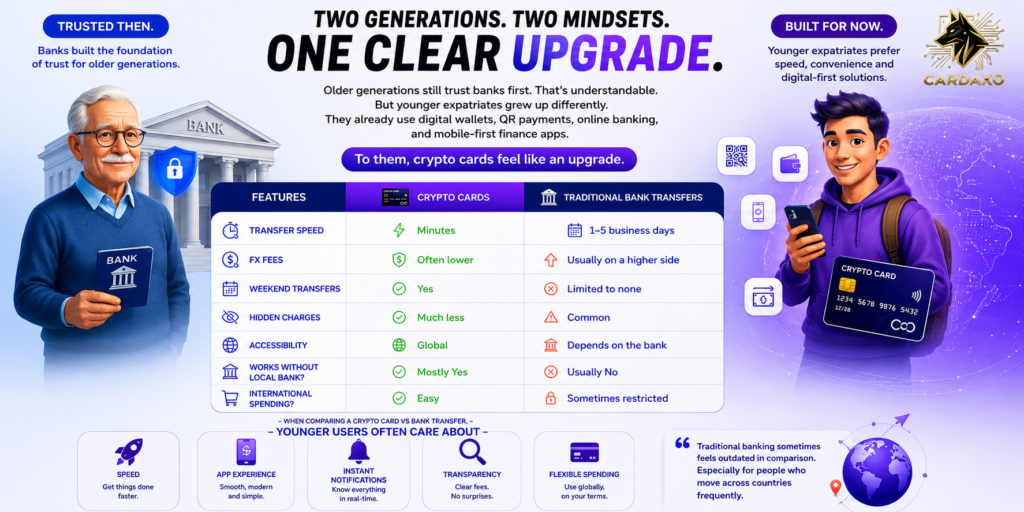
Older generations still trust banks first. That’s understandable. But younger expatriates grew up differently. They already use digital wallets, QR payments, online banking, and mobile-first finance apps. To them, crypto cards feel like an upgrade.
When we compare the two, we come across a lot of points that matter the most for the expatriates.
Features | Crypto Cards | Traditional Bank Transfers |
Transfer Speed | Minutes | 1-5 business days |
| Ofter lower | Usually on a higher side | |
Weekend Transfers | Yes | Limited to none |
| Hidden Charges | Much less | Common |
Accessibility | Global | Depends on the bank |
| Works Without Local Bank? | Mostly Yes | Usually No |
| International Spending | Easy | Sometimes restricted |
When comparing a crypto card vs bank transfer, younger users often care about
- Speed
- App experience
- Instant notifications
- Transparency
- Flexible spending
Traditional banking sometimes feels outdated in comparison. Especially for people who move across countries frequently.
The Hidden Advantage: Avoiding Multiple Currency Conversions
A decade ago, people earned money locally and spent locally. This is now changing with time. Today, people prefer to freelance globally, work remotely, receive crypto payments, and manage multiple currencies simultaneously.
The complexity of the system can be summarised as a software developer in Portugal might get paid by a company in Singapore while supporting a family in Brazil. Traditional banking systems struggle badly with this kind of lifestyle, whereas crypto cards fit naturally into it.
Thus, it will not be wrong to say that while searching for the best crypto card for expats, it is seen that the shortlisted ones:
- Supports multiple currencies
- Offers virtual cards
- Handles stablecoins smoothly
- Minimizes FX conversion costs
In short, convenience matters as much as fees now.
Virtual Cards Are Becoming Popular Among Expats
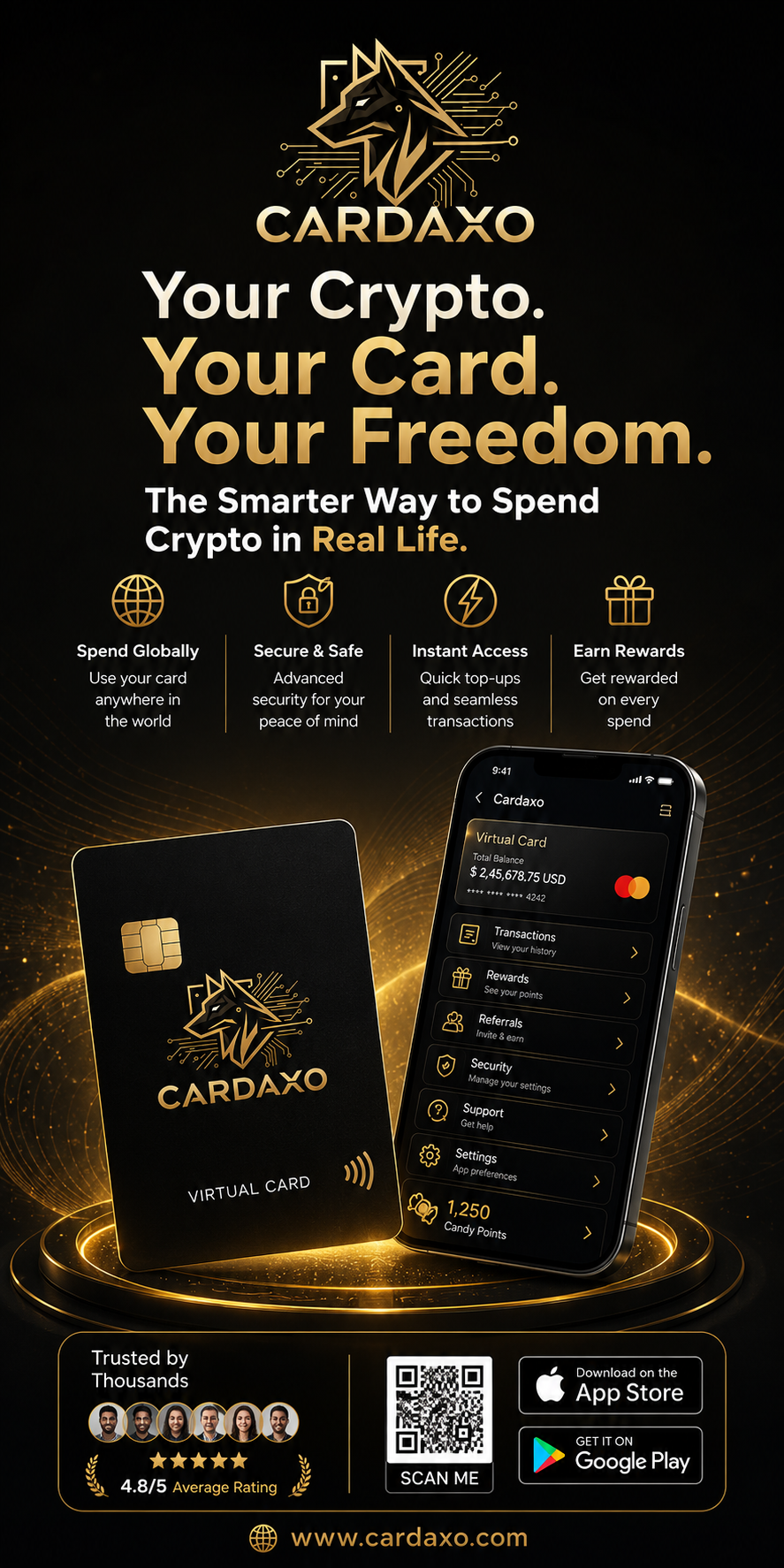
One of the biggest shifts in international finance is the rise of the virtual card for international transfers. Physical cards are no longer always necessary. Users, instead of waiting for a physical card to arrive, can simply apply for a virtual crypto card like Cardaxo. It can be created instantly, lets users make global online payments, manage spending through their apps, and lets you use your crypto hassle-free.
For people moving between countries for work, virtual crypto cards can solve a lot of practical problems. Just imagine how many extra jobs one has to manage while relocating. Apart from searching for accommodation etc., one has to look out to open a bank account, which abroad can take weeks. Then again, getting into a rabbit hole of transferring money and losing some of it in the process.
On the same hand, the Cardaxo virtual crypto card can be activated within minutes and can be used almost anywhere Mastercard is accepted. This flexibility is what is required the most in today’s scenario.
Important Things to Know: Safety, Taxes & Regulations Is It Safe?
Using a crypto card for international transfers can feel unfamiliar at first, especially if you’ve always relied on banks or traditional remittance services. However, crypto cards can be safe when used correctly and responsibly. Platforms like Cardaxo use multiple layers of protection, including:
- Encrypted Web3 wallet security
- KYC verification to confirm account ownership
- Two-factor authentication (2FA)
These features are designed to make sure that unauthorized access to the account is more and account security is premium.
Still, like any digital financial platform, it solely depends on the user’s awareness. It is often seen that the most common issues are human errors. One has to make sure to remember the security phrase or passwords. Also, cross-check twice to avoid sending funds to the wrong address. These errors can be corrected by simple measures.
Safety Checklist
- Download the Cardaxo app only from official app stores
- Enable 2FA immediately after creating your account
- Start with a small transfer to test the process
- Use a strong and unique password
Taking these steps significantly improves account security and reduces risk.
Tax & Legal Considerations
When it comes to taxes and regulations, the rules can vary depending on where you live. In many countries, sending your own money home is generally not considered taxable income because it is simply a personal transfer. However, some regions may still require crypto-related transactions to be reported for compliance purposes. Because laws differ from country to country, it is always recommended to consult a qualified accountant or tax advisor in your region.
To make sure you have a record of your crypto spending, Cardaxo provides transaction history and downloadable reports that can assist with personal record keeping and tax preparation.
Challenges Expats Still Face
Although crypto cards allow for faster transfers with relatively lower transaction fees, such payment methods are not the answer to every financial problem. It would be wise for potential users to consider all the pros and cons before starting to use such cards.
First, there is the question of regulation. In some countries, crypto payments and the use of cryptocurrencies are allowed freely, whereas in others, such activities are regulated by certain restrictions.
Secondly, one still needs access to some cash-out services at the receiving end in case a person prefers not to use crypto directly but to have regular currency. There can be difficulties converting digital currency into actual money when dealing with certain locations.
Moreover, for some people, the use of crypto can be an extra effort due to a lack of knowledge. Working with crypto wallets or making digital transfers via mobile applications can be an overwhelming task to manage.
Older relatives who have never used crypto may also find it difficult to understand. They may require additional help in figuring out how crypto works and what steps to take to transfer funds successfully.
Scams are another factor to look out for. The best way to avoid them is by sticking with reputable service providers when sending digital money. Finally, some providers advertise low transfer fees while quietly adding costs through unfavorable exchange rates or currency conversion margins.
All these issues, although small, can be tiresome and can make sending crypto a hassle. However, proper knowledge and transparency can change the game.
The most effective approach usually combines trusted exchanges, stablecoins for reduced volatility, transparent crypto card providers, and careful comparison of fees and exchange rates before making transfers.
Final Thoughts
For decades, international money transfers have been frustratingly expensive for expatriates.
People leave the comfort of their homes to create better opportunities for their families, yet traditional financial systems fail them, taking a meaningful percentage of every payment they send back.
Crypto, with the help of crypto cards, is changing that narrative. They’re not perfect and still require caution, education, and smart platform choices. But through something far simpler, they are making global money movement cheaper, faster, and more accessible.
For many overseas workers today, crypto isn’t about becoming rich overnight. It’s about ensuring more of their hard-earned money actually reaches the people they care about most.
For More – Cardaxo Blogs